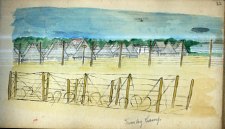
Frimley camp as painted by Heinrich Schmitz
This area of heathland some two miles from Frimley and close to Aldershot, was used as training ground by the Army and thus readily available at short notice when the decision to arrest all German and Austro-Hungarian males of military age immediately on declaration of war. It would appear to have been in operation within a week of the start of the war. This camp was a magnet for sightseers who came to see view the 'caged' Huns behind the barbed wire.
It was always a temporary camp using tents - used for civilians from early August until October 1914, it also housed combatants(other ranks) nominally in a separate compound; It was re-opened in April 1915 with somewhat improved facilities for originally combatants (other ranks) but following the sinking of the Lusitania in early May 1915 expanded to house around 2000 civilians until they could be moved to Stobs or Knockaloe.
Briefly re-established on a different site in summer 1916 as a combatant work camp being close to Longmoor where a railway was being built. Re-opened again in August 1918 to house combatants.
Its final appearance was as a civilian camp from June 1919 when Alexandra Palace was closed and those internees who were awaiting decisions as to whether they could remain in the UK were decanted to live under canvas - though the threat of life under canvas persuaded some 50-100 to accept 'voluntary' deportation.
A description of life in the first camp was found in the diary of Ludig Baur who died in the 'riot' at Douglas Camp in November 1914 - he was transferred to "that famous place at Frith-Hill, which will be an eternal disgrace to England". From his own account he would appear to have arrived in the camp around the 21st August and transferred to Douglas some two months later around the end of October.
A sketch book created by one of the later departees who were sent to Knockaloe shows a desolate piece of heathland with barbed wire
Frimley camp as painted by Heinrich Schmitz
The haste to establish the camp to cope with the large number of internees would explain the poor conditions as described by Baur
"I will not mention the fights we had to get food, wood & everything else, but it will be a everlasting disgrace for a cultivated nation, as well as the dirt and arrangements for washing & sanitary perposes, water & so on. We did no more look like human beings we became rude and rough, it is not to wonder. So we passed another 3 weeks, then we received at last boards to sleep on
...
I have forgotten to say, that we had nothing to eat our food with for 3 weeks we had to eat it with our 5 fingers & put our meat & potatoes on pieces of paper.
So the time passed along another 2 weeks, & by that time we at last received plates spoons & knifes"
There would appear to be a mixing of Civilians and Combatants.as Baur states
... in the meantime we had 75 soldiers in our camp, where we at last heard of the deeds of our army & became convinced that our country was going to win, which made us very highspirited again & who told us of the treachery of the Belgian populari [people]. Meanwhile they had build annother Camp, where they brought about 2000 German soldiers, fine looking man and not by any means halfstarved.

P.o.W Camp A Sunday Morning July 1915
A talented artist George Kenner (orig Kennerknacht) was interned following the sinking of the Lusitania in May 1915 and along with some 2000 others housed in the re-established camp. This time the camp was better supplied - the watercolour shows the floor boards, the provision of bowls etc. Kenner, unlike most others, was happy with living under canvas and remained there until the smaller 'privilege' section was the last to be emptied.
The food was prepared by the interned combatants in an adjacent camp.
This camp would appear to have continued to use the same list as Alexandra Palace - there are many entries in the ICRC lists of a transfer from Alexandra Palace to Frith Hill on the 7th June 1919 in which the camp numbers remain the same. I haven't found any account of life in this camp - I presume it used similar bell tents, though the Home Office report rather pointedly noted that
" volunteers [for repatriation]continued to come in satisfactorily, Frith Hill supplying the majority as the P/W's were somewhat unsettled there, until the signature of the Peace Treaty by Germany when the Home Secretary decided the time had now come for the release of those men whom the Advisory Committee had recommended should be permitted to remain here"
It closed at the end of September 1919
The Frith Hill Camp had only about 150 men left, and it was considered desirable to close this Camp first. Accordingly on the 22nd September, 1919, the remainder of the P/W's there were concentrated at Islington.
Graham Mark Prisoners of War in British Hands during WW1 The Postal History Society 2007 ISBN 978-0-85377-029-9
see https://sites.google.com/site/frimleyandcamberley/frith-hill-p-o-w-camp-at-frimley for a description of Frimley in 1914.
|
|
||
 |

|
|
|
|
||
| Any comments, errors
or omissions gratefully received The
Editor Text + Transcription © F.Coakley , 2025 |
||