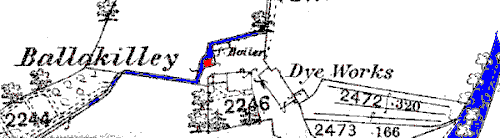
(79) Ballakilley Tuck Mill


From 1868 O/S PlanS IX/7 & IX/8 - SC 279824

The Dye works lies at the corners of 4 sheets of the 25" O/S plans - the above is an amalgam of the two upper sheets, as the two lower sheets hold no relevant details. The old house is that above '2246' on the plan, the tenter field or drying frames are plots 2472 & 2473. The sale description of 1850 of being in operation upwards of 80 years implies an establishment in the 1770s or early 1780s.

There is a description, [Manx Museum FLS C/262] of the complex of buildings taken in 1974 as part of the IoM Folk Life Survey

Ballakilley Farm, St John's. Old Buildings - a dwelling-house there - one room up and one down, very small and with a small fireplace at one end of the downstairs room - no chiollagh.Adjoining it but apparently unconnected with it as another "room" completely divided off by a wall. This had a door in the upper storey to which there was once a flight of steps, which have been removed, but the mark of them can be seen on the wall. No-one has lived in this old house within living memory as the building has always been used as an outhouse. There is no chimney, but a stack may have been taken down - it has a tin roof now.
The next building in this block is of interest. From the outside it looks like an old farmhouse, and even at a first glance inside, would appear to have an enormous open fireplace at one end. However it never was a dwelling house, but was a dyehouse-belonging to the woollen mills. It is of two storeys, each consisting of one very large room. Though the general idea is that it was always a dyehouse Mr. Corlett of Ballakilley says that there is also an idea that it was once a mill - a channel runs down from it to the river through this is covered over now.
The field in front of the dyehouse is known as the "tenter field" - he said tender field. At the back of the building there were once large pits which he filled in - these would presumably be the dyeing vats. In the end gable of this building there are five windows: the roof looks extremely old, has little slates and the small light laths of wood can be seen under the slates, which are probably pegged on over the lats. There are some very strong lengths of wood stretching from front to back supporting the upper floor.

The 1850 advertisement mentions a Walk or Tuck mill - however Ann Killey the wife of George Radcliffe had inherited a long established tuck mill near Ballig Bridge but the advert states "Walk or Tuck Mill, driven by water, and erected within the last two years" - my conjecture is that any newly built tuck mill on the dye-house site was south of the building marked 'boiler' - however the mill race is quite long and possibly the supply is not plentiful, neither is it indicated on the 1868 O/S plain.


Manx Sun, 28th September 1850:

TO DYERS, MANUFACTURERS, &c. TO be LET, from the 11th of November next,—All that old established and well-accustomed DYEING CONCERN, known by the name of "Killey's Dye Works," situate near St. John's, and within three Miles of the Town of Peel, now in the holding of Mr. GEORGE RADCLIFFE. The Concern has been established upwards of Eighty Years, and has always been held in good repute in the Island. The Premises comprise Dye and Press Houses, Walk or Tuck Mill, driven by water, and erected within the last two years ; Bleach Green, &c. A good stream of Water runs through the Premises, on which the Manufacturing Business might be advantageously carried on. A comfortable DWELLING HOUSE, with Garden attached, and suitable Out Offices, Threshing Mill, &c. and from 5 to 100 Acres of Land, may be had with the Works. Application to be made to ROBT. C. QUIRK, Esq., Knockaloe; or to ROBT. J. MOORE, Advocate, Peel. September 22, 1850.

George Radcliffe would from a reported court case be the widower of Anne Killey

Manx Sun, 21st May 1859:

Law Intelligence.

ADJOURNED CHANCERY COURT. CASTLETOWN, THURSDAY , May 19. The Court assembled at 10 o'clock, all the members being present. GEORGE RADCLIFFE , Executor of Ann Radcliffe, Complainant, v. JOHN QUIRK and WILLIAM BISSETT, Executors of John Crellin, Defendants. Mr. ADAMS for complainant. Mr. GELL for defendant, Quinney. The defendant Bissett, resides off the Island. Final argument on bill, answer and depositions. Bill filed to recover from the defendants as executors of John Crellin, the sum of £20, with interest, being the amount of a joint and several promissory note, dated 8th September, 1836, passed by John Crellin and Richard Crellin to Ann Killey, who married the complainant, and died in June, 1852, having first made and published her last Will and Testament whereof the complainant was appointed executor. By the defendant Quinney's answer it appeared that Ann Killey transferred and assigned certain real and personal property including the promissory note now sought to he recovered, to trustees, for the benefit of her children, who are yet living, and that the note had been endorsed to one Margaret Collister, a sister of Ann Killey. The defendants therefore did not feel justified in discharging the amount of the note, unless releases, disclaiming all interest therein, were executed by those parties who might perhaps hereafter claim to be entitled to the amount thereof Mr. ADAMS having stated that releases had been duly signed. the Court granted a decree tor £20, with interest thereon at 5 per cent, from 11th September, 1836, but without costs.


Index  

Water powered Mills etc

Any comments, errors or omissions gratefully received The Editor
© F.Coakley , 2024