
[Taken from Magazine of Art pp178/182 1895]
WRITTEN By E. RIMBAULT DIBDIN.
Illustrated BY HERBERT RAILTON.
MIDWAY between the North of England and the green land of patriots and potatoes there rises from the waters of the Irish Sea a large and beautiful island, which is described by the polite as the Kingdom of Man. From its topmost pimnacle which soars some 2,054 feet above the utmost wave of high-water, you may see, if you are fortunate, a sight which no other place will afford you; for Man is so situated that the peak of Snaefell commands a view of the adjacent realms of England, Scotland Ireland, and Wales. Elaboration of detail is not, by any means, a characteristic of the prospect, even in the finest weather—especially as regards Wales, Even in Scotland, which is much the nearest, it is only with a good glass that you make out the houses and trees of Southern Galloway. On most days nothing is to be seen on any side beyond a watery horizon, for even when it is sunny there is usually soft, dry haze in the air. This, according to that most fervent of Manxmen, Mr. Hall Caine, is due to the old-time enchantments of the potent magician Mannanin, who, having no mind for promiscuous company, concealed his chosen home from passing seafarers in a cloud of mist. Such a comparatively tenable theory must certainly be accepted in preference to the preposterous ascription of the mists to the vengeance of a slighted mermaiden, put forward hy the poet Collins in a footnote to his lines on—
"Mona, once hid from those who search the main,
Where thousand elfin shapes abide."
Mannanin is gone hence, and the mists called up by his art-magic have lost their old power. I have often seen the outline of distant Mona from the lofty sides of Penmaenmawyr, and from the Down coast, in the clear light of dawn or sunset. I have even shown it to confiding friends (though without seeing it myself) from the much less elevated top of Bidston Hill in the Wirral Peninsula. So far as the visitor is concerned there are now no "elfin shapes" in Man, but if you can get the people of the island to open their hearts, you will find the place in their keener imaginations is still full of them—good, bad, and indifferent; potent on sea and on land, and held in unconfessed awe.
Mona (she shares the name amicably with Anglesea) is fortunate in many things; and it is not without reason the natives call it "veg veen"—the dear little island. The climate is charming, and the severities of winter—save only its storms—are almost unknown. The surface of the country is delightfully varied in character, and though the hills are of moderate height and gentle of contour, they are intersected by innumerable glens of striking beauty.
The nearest English approach to Manx scenery is in the hill country of Derbyshire, but a comparison is all in favour of the island; for, if its rivers are insignificant, it is set in the midst of the sea, and has a beautiful coast-line. Trees flourish only in a few sheltered places, but the vegetation is otherwise exceptionally luxuriant, and in the south of the island great hedges of fuchsia are as common as thorn. After beholding the radiant glory of a Manx hillside in May, one no longer wonders why Linneus was moved to kneel in adoration of the first gorse bush he saw.
The approach to Mona cannot fail to prejudice you strongly in her favour. Almost all the steamers ply to Douglas, which lies midway on the eastern coast, along a semicircular bay of distinguished beauty, guarded on either side by cliffy headlands. Beyond the town and the picturesque surrounding country the highest hills of the island are arranged in agreeably effective disorder of line. If the approach be, as it usually is, in the evening, the appearance of the scene, gorgeously arrayed in the colours of sunset, is so impressive as to excuse—if it does not justify—the Manxman's rooted conviction that Douglas Bay is the most beautiful bay in the world. At that hour the last touch of beauty is usually given to the picture by the graceful lines and striking colours of the boats slowly and silently setting out for the fishing grounds.
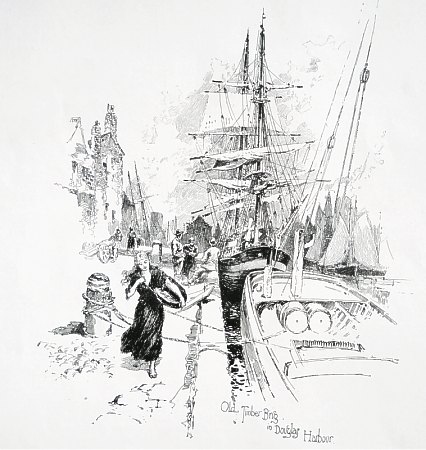
Poetical impressions are promptly dissipated when the pier is reached, and the wild, though well-restrained, bustle of landing begins. All Douglas seems to turn out on such occasions, and were it not for the excellent order preserved by the authorities, the new arrivals would be in danger of dismemberment by eager lodging-house keepers, porters, hack drivers, and other touts. In former years, ere such strict rule prevailed, one's progress from the landing-place to the town was only accomplished with much difficulty and discomfort. Douglas is the ideal resort of the toiling millions of Lancashire and Yorkshire, and often accommodates in its hotels and lodging-houses more "trippers" than the normal population of the island, which at the last census was computed to be 55,415. As a seaside resort for the northern counterparts of 'Arry and 'Arriet it is unrivalled. All that the natural man can desire in the way of healthy and delightful recreation is here in abundance, cheap, and of the best quality. Boating is safe (unless you insist too obstinately on over-tempting Providence); comfort and convenience in bathing are well provided for, in water of that crystalline purity only seen around islands ; cliffs, creeks, glens, and country roads offer endless variety to pedestrians of all shades of capacity ; hills of quite respectable bigness invite the climber: the air is perfect, the town is clean, orderly, and commodious, the people are amiable and friendly, and extortion is almost unknown. For the unnatural man, who aspires to make his annual holiday a riotous period of alcoholised revelry, the attractions of Douglas are also ample. These, however, are excellently controlled, and the recreations of the rougher sort do not seem to be allowed to come betwixt the wind and the gentility of more orderly folk. Still, Douglas is first and chiefly a place for those of the middle and lower classes who are gregarious in their enjoyments ; and a more charming and desirable spot they could scarcely discover.

Those who take their pleasures less strenuously do not tarry long in Douglas, beautiful as its surroundings are, but make haste to towns and villages where the life is quiet and quaintly simple—where the dreaded trippers are unseen, save when occasional trap-loads from Douglas alight at the local public-house in quest of matter that will beguile the tedium of hilarious travel. Even then they are no encumbrance, for they never dream of dispersing, being as unconscious as cattle of picturesque beauty, It is only when a speculator fences in a waterfall or chasm and charges twopence a head to see it that such travellers will go to look. Probably the most generally appreciated piece of scenery in all Manxland is that hideous, colossal water-wheel, seventy-two feet in diameter, which is the ugliest thing in the once beautiful Laxey glen, now blasted and disfigured by the operations of lead-mining, The wheel is the largest in the world—the only largest thing in the world in the island; therefore how beautiful and wonderful to the unceasing parties of trippers who make it the object of their excursions! It is a fortunate law of nature that the most dreaded class of excursionists is never inclined to ramble, and above all things never walks. Douglas is all-sufficient for its lovers, and the only variations ever indulged in are a sail on the bay, a trip round the island in a steamer, or a drive at so much a head along the high roads. When I first visited the land of tailless cats nearly twenty years ago, I abandoned attempts to walk on the public ways near Douglas because of the volleys of mockery fired at me from every vehicle that passed, accompanied often enough by more formidable missiles. The simple-minded factory operative could not away with the incredible meanness of a man who would tramp the dusty roads (and they were dusty !) rather than ride in agreeable company (his company) all day for a florin
The Douglas of to-day is a well-planned, spick and span watering-place. Twenty years ago the principal streets were mere tortuous alleys, narrow as city lanes; the spacious promenades and piers were little more than projects, and the present sea front was under water, Old Douglas still exists, enveloped in the newer town, and the old harbour with its quaint craft is little altered. The real native life of the town goes on here, the more attractive new quarters are merely the ramifications of a huge caravansary.
Far up the harbour you come to the terminus of the local railways, whence odd-looking toy trains bustle off along narrow-gauge lines to the west and south. The arrangements are not of the most advanced kind, and stern punctuality is out of the question, since the mail boats, uncertain like all sea things, to some extent regulate the times of departure. The trains rattle along contentedly, and are not above a halt midway between stations to pick up a passenger. A journey along the southern line is rewarded by glimpses of much beautiful scenery.
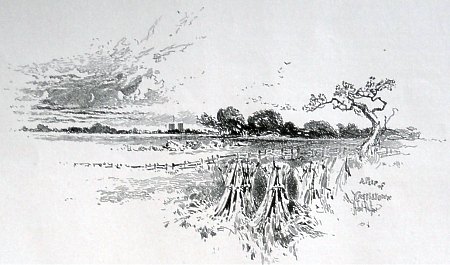
Few fail to alight at Castletown, formerly the capital, and still possessing in Castle Rushen the only fortress on the island. It stands picturesquely at the estuary of the Silverburn, and is content in its old age (which easy-going antiquaries are prepared to believe is nearly a thousand years) to serve as a show place. It was in old times the residence of the kings of Man, and, after they sold their sovereignty to England, of the governors. Last of all, it did duty as a prison. At no great distance is King William's College, an important educational institution, the tower of which forms one of the chief features in a distant view of the town. Not far off is Hango Hill, where the Manx Judas, William Christian, was shot—ending a very dubious career in an edifying manner. Christian—"Iliaim Dhoan," or Brown William, was his popular name —was the Earl of Derby's receiver-general in the stormy times of the great rebellion. Sir Walter Scott, with that fine artistic freedom of handling which characterised him, mixed him up harmoniously with another Christian (the surname is a common one in the island), just as he confounded Castle Rushen with Peel Castle. The Earl naturally declared for the King—for his brother-King, he being monarch of Man—and sailed with volunteers, and £500 subscribed by his subjects, to Lancashire, where the Parliament-men promptly took, tried, and executed him.Christian left in charge of the island and the Countess, played a double game, sowed disaffection, disbanded his troops, seized forts, and, when the Parliament army landed, received it with instant submission. As a result, he was made governor of the island, While the Countess was clapped into prison. Prosperity, however, did not remain long with him. He abused his trust, misapplied the public funds, and eventually found himself, in London, in the Fleet Prison. When the Merry Monarch came back to enjoy his own again, the island kingdom of the Stanleys was restored to them, and the Countess-Dowager ruled it once more. Released somehow from the Fleet, Christian, trusting to the Act of Indemnity, returned to Mona. This, however, was a grave miscalculation: the Countess-Dowager had no mind to let any of her debts go unpaid, and she at once had the unfortunate man arrested on a charge of treason. The House of Keys tried him, and he was condemned to die. A nephew hastened to London, and got the King to suspend the sentence, but the Countess's justice was too expeditious for him, and Christian was shot. The soldiers charged with his execution desired to bind him, but he bade them save themselves the trouble—he was not afraid. Then he pinned a piece of paper on his breast as a mark, told them to aim there, gave the signal to fire, and fell, shot through the heart. A fuller account of this stirring incident in the island's annals may be found in Mr. Hall Caine's charming book, "The Little Manx Nation," to which I am indebted for these brief details.

A few miles from Castletown, and nearer to the Calf of Man (the island, say the humorists, has three legs, but only one calf), is the little herring-fishers' harbour and village, named Port St. Mary. In this quiet romantic spot visitors get very near to the real unadulterated life of the island, and it is a favourite resort of those unaffected folk who prefer their seaside life without any tincture of city manners and fashions. The natives declare residence there to be a sovereign cure for rheumatism in particular, as well as all other bodily ills in general; and it is certainly a place where it is very difficult to avoid being healthy. Myr. Railton's view is taken from the near vantage-ground of Gansey Point, where the popular Liverpool portrait punter, Mr. R. E. Morrison (who, by the way, is a Manxman), spends his summers in the distraction of landscape-painting ; for painters, like the actor who employs his spare evenings in going to the play, always carry their art wherever they go. Port St. Mary and the adjacent Port Erin are favourite resorts of Liverpool painters, and they are certainly admirable as sketching centres.
It is not a very great distance from Port St. Mary to Peel and a walk by the tracks alone the cliffs will introduce a pedestrian to miles of varied coast scenery well nigh as grand and beautiful as any in the United Kingdom. From Douglas, however, the way by rail or road is directly across the island, for Peel is the western port. The railway line has now been continued in a northerly direction, till it returns to the eastern side of the island at Ramsey, sixteen miles north of Douglas; a popular watering-place for folk of the soberer sort.

Not very far from Ramsey, to the south, is St. Maughold's, a place rich in ancient crosses and other remains. One cross by the roadside is popularly said to be the petrified body of an old woman who was turned into stone for sacrilegiously cursing the wind, against which she was vainly trying carry a load of wool—a sort of Manx Lot's Wife The poor old lady commands the sympathy of all who know the quality of Manx gales. Near the gate of the churchyard is a comparatively well-preserved four-sided cross of unknown date, figured here by Mr. Railton, who has shown the face which is adorned with a crucifix and the Manx arms. Apropos of the latter no one seems to have remarked the curious resemblance to the ancient arms, the Trinacria, of the sun-steeped island of Sicily. The three mailed legs of Man (supposed popularly to kick defiance of England, Scotland, and Ireland) are surrounded by the motto "Quocunqgue jeceris stabit," while the bare Sicilian legs have the legend: "TIANOPMITAN." and are joined by the head of the Gorgon Medusa a disagreeable female, who seems from a bas-relief in the Palermo Museum (the oldest known example of Greek plastic art to which a date can be assigned) to have been three-legged. Scholarship should be able on the basis of this resemblance to prove a Sicilian colonisation of Man. At present, history begins with Celts of undefined origin, then goes on to the successive dominions of the Welsh, the Norse Vikings, the Scots, and the English. The Norsemen nearly a thousand years ago gave the island a constitution, which survives to this day, and provides a perfect system of home rule—the only survival of the ancient Icelandic method of government by an open-air assemblage of representatives of the people. On the Tynwald Hill, in the centre of the island, the laws are still confirmed on each Midsummer Day at a solemn gathering presided over by the Governor, attended by his "Keys," clergy, deemsters, coroners, and people. "Our little nation," says Mr. Hall Caine, "is the only Norse nation now on earth that can shake hands with the days of the Sagas and the sea-kings".
|
|
||
 ![[Full Text Index]](../logo.gif)
|
||
|
|
||
| Any
comments, errors or omissions gratefully received The
Editor HTML Transcription © F.Coakley , 2026 |
||